
- Education
- Estimated reading time:6 min read
How Storefront UX Impacts Ecommerce Growth More Than You Think
- By Stoify
Explore how user experience decisions across navigation, layout, and interaction design directly influence ecommerce conversions, trust, and long-term customer retention.
Share this page
For ecommerce brands, user experience is often treated as a design layer added after the core functionality is complete. It is seen as colors, spacing, and visual polish. While those elements matter, they only scratch the surface. In reality, storefront UX directly shapes how customers navigate, evaluate products, and decide whether to purchase.
Every interaction, from clicking a product card to filtering a category page, contributes to the overall experience. When those interactions feel smooth and intuitive, users stay engaged. When they feel confusing or inconsistent, friction builds quickly.
This is why UX is not just a design concern. It is a growth driver.
At Stoify, UX is approached as part of a unified ecommerce system. It connects with product data, performance, and storefront structure. When these elements work together, UX becomes a tool for increasing conversions rather than just improving aesthetics.
That connection is visible in practical details: variant selection should be clear, product media should support the decision, stock availability should not contradict the call to action, and account features such as wishlists should give shoppers a useful way to return later. UX is strongest when it reflects the real commerce state behind the page.
UX defines how users explore your store
When a customer lands on your storefront, their first goal is simple: understand what you offer and how to find it.
If navigation is unclear or overwhelming, users struggle to take the next step.
Common UX issues that disrupt exploration
- Overcomplicated navigation menus with too many choices
- Poorly structured categories that do not match user expectations
- Lack of clear product hierarchy or grouping
- Inconsistent layout patterns across pages
These issues force users to think too much. The more effort required to navigate, the more likely they are to leave.
Good UX reduces cognitive load. It guides users naturally from one step to the next without requiring effort or guesswork.
Clarity increases conversion rates
A well-designed storefront makes decisions easier.
When users land on a product page, they are looking for specific information:
- What is this product?
- Why should I buy it?
- How much does it cost?
- What do I do next?
If this information is hard to find or poorly presented, conversion rates drop.
How strong UX improves clarity
- Highlighting key product details above the fold
- Using consistent layouts for product pages
- Making pricing and variants easy to understand
- Ensuring call-to-action buttons are obvious and accessible
Clarity removes hesitation. When users understand what they are buying, they are more likely to follow through.
The role of consistency in building trust
Consistency is one of the most underrated aspects of UX.
When elements behave predictably across the storefront, users feel more comfortable. When layouts, buttons, or interactions change unexpectedly, it creates doubt.
In ecommerce, that doubt can directly impact sales.
UX inconsistencies that hurt trust
- Different button styles across pages
- Changing layouts between similar product types
- Unexpected interaction patterns in filters or navigation
- Misaligned spacing and visual hierarchy
Consistency creates familiarity. Familiarity builds confidence. And confidence leads to conversions.
Why mobile UX is critical
A large portion of ecommerce traffic comes from mobile devices. This makes mobile UX one of the most important factors in overall performance.
However, many storefronts are still designed with desktop in mind first.
Mobile UX challenges
- Small tap targets that are difficult to interact with
- Overcrowded layouts that do not adapt well to smaller screens
- Slow or clunky filtering experiences
- Long, unoptimized checkout flows
Improving mobile UX often leads to immediate gains in engagement and revenue.
This includes simplifying layouts, prioritizing key content, and ensuring interactions feel fast and responsive.
UX and product discovery
Discovery is a core part of ecommerce. Users rarely land on exactly the right product immediately. They browse, compare, and refine their choices.
UX plays a major role in how effectively users can do this.
Poor discovery experiences lead to
- Users missing relevant products
- Frustration with filtering and sorting
- Higher bounce rates on category pages
- Lower overall engagement
Strong UX improves discovery by
- Providing intuitive filtering and sorting options
- Displaying products in clear, scannable layouts
- Using visual cues to highlight important items
- Reducing friction in navigation between categories
The easier it is to discover products, the more likely users are to find something they want to buy.
Micro-interactions shape perception
Small details often have a big impact.
Micro-interactions, such as hover states, loading indicators, and button feedback, help users understand what is happening as they interact with the site.
Without these signals, the experience can feel unresponsive or broken.
Examples of effective micro-interactions
- Instant feedback when adding a product to cart
- Smooth transitions between pages or states
- Clear loading indicators during data fetches
- Subtle animations that guide attention
These details improve perceived performance and make the storefront feel more polished and reliable.
UX supports long-term retention
User experience does not just impact first-time conversions. It also affects whether customers return.
A positive experience makes users more likely to:
- Come back for future purchases
- Recommend the store to others
- Trust the brand over competitors
A poor experience has the opposite effect, even if the product itself is strong.
This makes UX an important part of long-term ecommerce strategy, not just short-term optimization.
Trust signals matter here too. Published reviews, visible delivery and return information, checkout consent choices, and clear digital-product expectations all reduce uncertainty at the point where a customer is deciding whether to continue.
It also affects what happens after a customer leaves. If a shopper abandons a cart, a thoughtful reminder email can work like an extension of the storefront experience. In Stoify, these manual reminders are part of the optional Abandoned cart recovery module, which is off by default and can be enabled from Settings → Modules. The tone, clarity, and timing still shape trust. A messy or generic reminder feels disconnected. A well-designed reminder that clearly shows saved items and points the customer back to the store feels like a continuation of the journey rather than a separate marketing blast.
Measuring UX impact
Like performance, UX should be tied to real business metrics.
Instead of relying only on visual feedback or subjective opinions, ecommerce teams should track:
- Conversion rates across different page types
- Bounce rates on landing and category pages
- Click-through rates on navigation elements
- Time spent on product pages
- Repeat customer rates
These metrics provide insight into how users are interacting with the storefront and where improvements can be made.
Scaling UX with your store
As ecommerce businesses grow, maintaining a consistent and effective UX becomes more complex.
More products, more categories, and more features increase the risk of inconsistency.
To scale UX effectively
- Use reusable design components
- Maintain consistent layout patterns
- Structure product data clearly
- Align design decisions with overall business goals
This ensures that the experience remains cohesive, even as the storefront evolves.
UX as a competitive advantage
In crowded ecommerce markets, experience often matters as much as product and price.
Two stores may offer similar items, but the one with the better UX will typically convert more customers.
UX becomes a differentiator.
Brands that invest in user experience are better positioned to:
- Reduce friction in the buying journey
- Build trust with new visitors
- Increase conversion rates
- Encourage repeat purchases
Designing for growth
Storefront UX is not just about making a site look good. It is about shaping how users think, feel, and act as they move through the buying journey.
When navigation is clear, interactions are smooth, and information is easy to understand, users are more likely to engage and convert.
That is why UX should be treated as a core part of your ecommerce strategy.
At Stoify, the goal is to make this easier by connecting UX with performance, product structure, and storefront logic. This allows ecommerce brands to build experiences that are not only visually appealing, but also designed to grow revenue.
For modern ecommerce businesses, that connection is what turns good design into real results.
Continue exploring
Related Stoify articles and feature pages connected to this topic.
Catalog
Product management that stays fast as your catalog grows
Manage product details, variants, media, digital downloads, categories, collections, pricing, and visibility from one focused workflow.
Growth & retention
Live cart tracking that shows intent before checkout
Monitor active and abandoned carts, understand shopper intent before checkout, and follow up with reminder emails when buying momentum fades.
Conversion
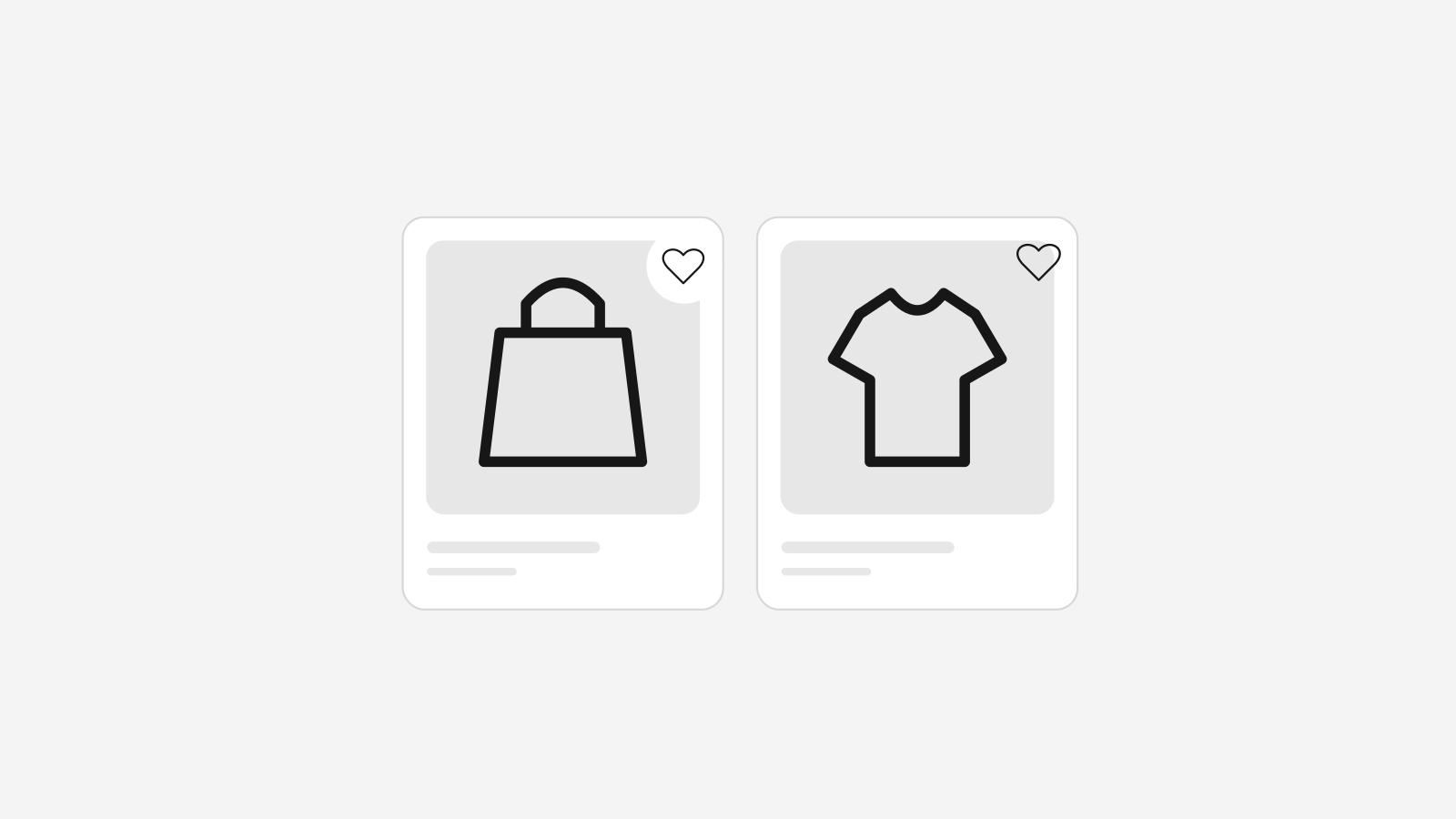
Customer wishlists for storefront demand signals
Let logged-in customers save product variants and give your team a clearer view of purchase intent from the Stoify dashboard.

Trust
Product reviews module with storefront trust and tracking
Enable reviews as a site module, publish verified product feedback, and track review intent with Google Analytics from the same Stoify workflow.
Visibility
Storefront SEO controls and audits in one workspace
Manage page metadata, canonicals, sitemap coverage, and mobile or desktop PageSpeed audits from the same Stoify workflow that publishes your store.